
The Relentless March of Computing Power
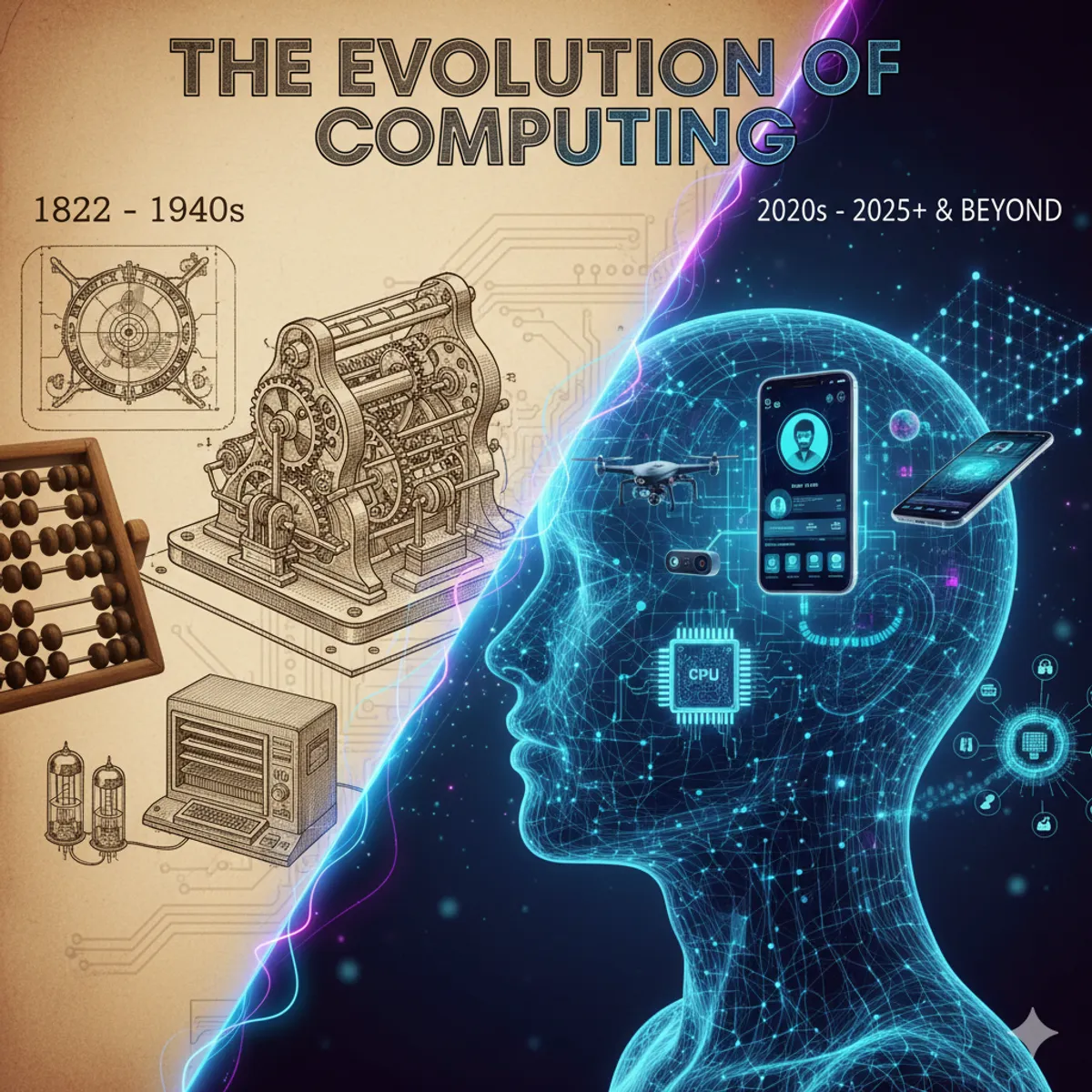
The journey of the computer is a testament to human ingenuity. From mechanical devices that calculated planetary orbits to Quantum Processing Units (QPUs) that manipulate subatomic particles, we have witnessed an exponential leap in processing power, often described by Moore’s Law.
The Dawn of the Digital Age: Early Computing (Pre-1950s)
Before electricity, mechanical engines like Charles Babbage’s Difference Engine laid the logical foundation. However, the true digital age was forged in the fire of World War II.
Definition (The Birth of Programmability)
ENIAC (1946) was the first general-purpose electronic computer, but it was The Manchester Baby (1948) that first demonstrated the “Stored Program” concept—the ability to hold both data and instructions in memory.
The Silicon Revolution (1960s-1990s)
The transition from vacuum tubes to transistors (1947) and later Integrated Circuits (1958) allowed computers to shrink from room-sized to desktop-sized.
- Mainframes: IBM System/360 unified computing architectures for the first time.
- Microprocessors: The Intel 4004 (1971) packed the power of a computer onto a single chip, sparking the PC revolution led by the Altair 8800, Apple II, and IBM PC.
- Graphical User Interface (GUI): Xerox PARC pioneered the mouse and windows, which were later popularized by the Macintosh (1984) and Windows 3.1.
The Networked & Mobile Era (2000s-2020)
Computing became social and portable. The launch of the iPhone in 2007 didn’t just give us a phone; it gave us a hand-held Unix-based supercomputer with persistent internet connectivity.
Modern Computing (2025): Parallelism & Heterogeneous Compute
Today, computing is no longer just about the CPU. We live in an era of Heterogeneous Computing, where specialized chips handle specific tasks:
- GPUs (Graphics Processing Units): Parallel processing for 3D and AI.
- NPUs (Neural Processing Units): Dedicated silicon for AI inference in smartphones and laptops.
- TPUs (Tensor Processing Units): Custom Google silicon for training massive LLMs.
The Quantum Horizon: A Paradigm Shift
Classical computing uses bits (0 or 1). Quantum Computing uses qubits, which leverage superposition and entanglement to represent multiple states simultaneously.
Important (Quantum Supremacy vs. Quantum Utility)
We have passed the stage of “Supremacy” (doing a task no classical computer can). Now, companies like IBM and Google are chasing “Utility”—using quantum systems to solve real-world problems in chemistry and material science.
Conclusion
Computing has evolved from a tool for calculation to the very fabric of our reality. As we push against the physical limits of silicon, the future lies in Bio-computing, Optics, and Quantum systems that will redefine what it means to “calculate.”
Recommended for You
Explore more articles on similar topics and continue reading.